
Uranium exploration geologistSalary, qualifications, career path and hiring demand, 2026 edition
A uranium exploration geologist develops and defines the geological systems that can become future uranium mines. The position combines field mapping, drill targeting, core logging, structural interpretation, geochemistry, radiometrics, geophysics, groundwater assessment, and 3D modelling to decide where the next hole should go and what the last hole actually means. In the Athabasca Basin, that often means unconformity-style mineralisation, graphitic conductors, alteration, fault architecture, and compliance with safety standards; elsewhere it can mean sandstone-hosted, intrusive, or metasomatic systems. The defining ability is turning incomplete geological evidence into testable exploration decisions while observing health and safety practices.
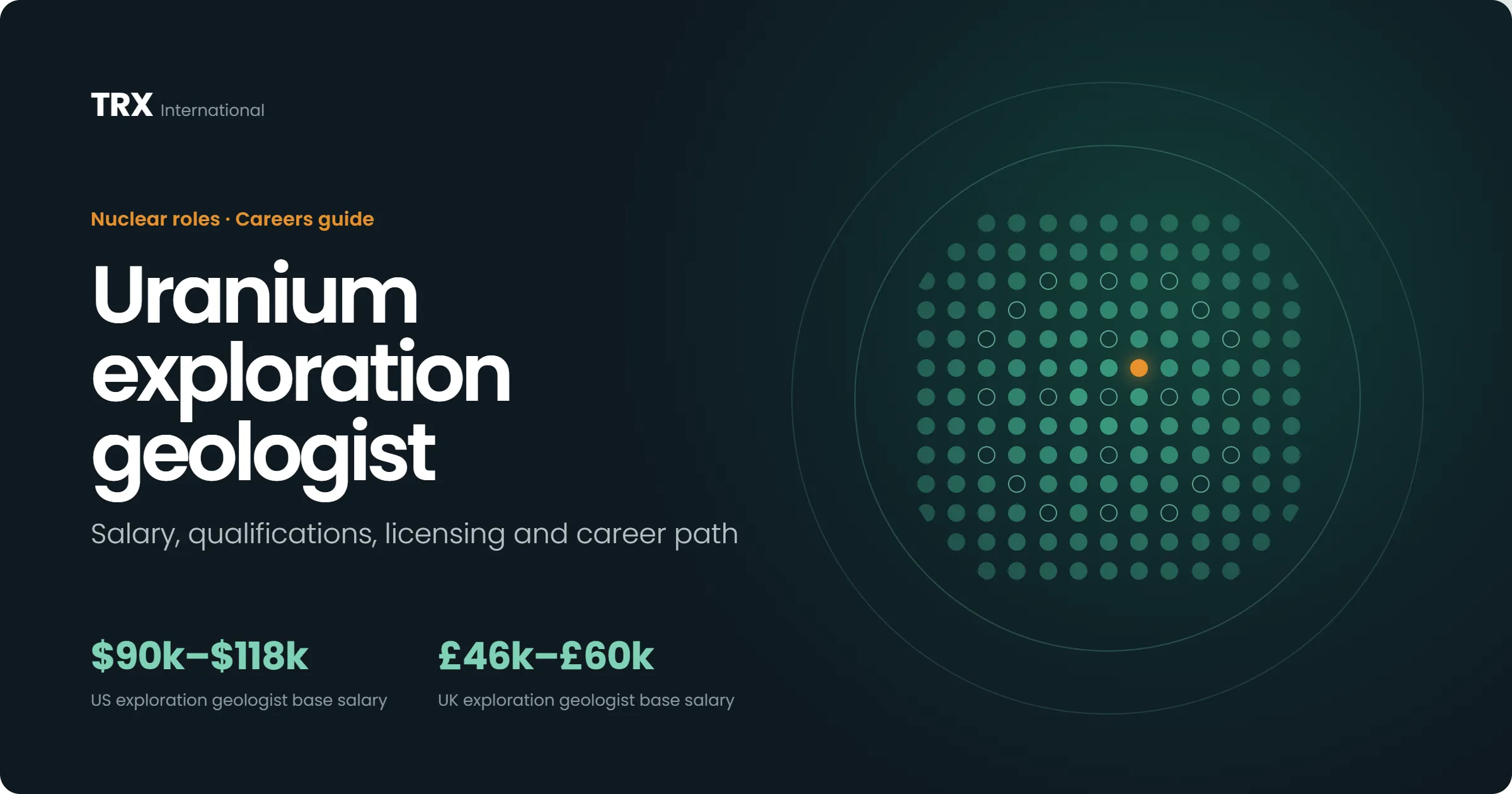
TRX’s 2026 model places established US uranium exploration geologists around $90,000–$140,000 base salary, with principal, project and exploration-management roles moving toward $165,000–$190,000. UK-employed international geologists commonly model around £46,000–£76,000, rising toward £90,000–£110,000 at principal or management level. Canadian uranium data is especially relevant: Orano’s current Saskatchewan Mining Geologist salary range is C$118,350–C$139,200 for a mid-career exploration/development role, reflecting years experience and permitting responsibilities.
A BSc in geology, geoscience or geological engineering is the standard entry point, followed by enough field and drilling experience to compile data and make defensible interpretations rather than only collect data. P.Geo or equivalent professional registration becomes important for senior project responsibility and technical disclosure. Uranium exploration adds radiometric tools, radiation-safety controls, geochemical pathfinders, alteration mineralogy and—in northern Canada—remote-camp competence. The strongest candidates can explain why a target deserves capital, not merely describe what the core or soil samples look like, and assist with other duties such as GIS mapping and facilities coordination.
The role at a glance
Everything an employer will ask about in the first fifteen minutes of a screening call.
- Also called
- Exploration geologist · uranium geologist · project geologist · field geologist · core logging geologist · discovery geologist · resource-definition geologist
- Entry qualification
- BSc in geology, geoscience or geological engineering; MSc helps for structural geology, economic geology, geochemistry or research-heavy programmes but is not mandatory.
- Typical entry pay
- $72,000–$92,000 US · £36,000–£46,000 UK-employed/international equivalent.
- Senior pay
- $110,000–$165,000 US for senior/principal project geology · £58,000–£90,000 GBP equivalent; exploration management can exceed these bands.
- Contract day rates
- Roughly £350–£500/day for field/logging work and £500–£700/day for senior interpretation, programme leadership or resource-definition assignments; North American contracts commonly model at $55–$110/hr.
- Professional gate
- P.Geo, CGeol or equivalent professional registration becomes increasingly valuable at senior level and may be needed for technical sign-off or Qualified Person pathways.
- Security
- Usually commercial exploration access rather than nuclear security clearance. Drug/alcohol testing, remote-site medical fitness and driver licensing are common.
- Where the work sits
- Exploration camps, core shacks, drilling programmes, geophysical surveys, project offices, geological modelling teams and resource-definition programmes.
- Travel
- High. Remote rotations, helicopters, winter roads, field camps and multi-week drill campaigns are normal in many uranium districts.
- Shift pattern
- Often long field days on rotational rosters. Drilling can run 24/7 even when geologists work day/night shifts or extended handovers.
- TRX segments
- Nuclear fuel cycle · Uranium exploration · Project development · Mining · New technology development · Resource evaluation
Six versions of the same job title
“Uranium exploration geologist” changes materially with deposit style, programme maturity and whether the objective is a new discovery or resource growth. Meter = relative hiring relevance across TRX’s 2026 market.
Athabasca unconformity exploration geologist
Targets structural corridors, basement conductors, alteration, geochemical halos and unconformity relationships in one of the world’s highest-grade uranium districts.
Discovery drilling geologist
Works close to active drill rigs, logging core, integrating downhole radiometrics and making rapid target-adjustment decisions as new geological information arrives.
Structural / target-generation geologist
Builds geological models from mapping, core, geophysics and historical datasets to define the structures and alteration systems most likely to focus uranium mineralisation.
Resource-definition geologist
Moves a discovery toward confidence and scale through infill/step-out drilling, geological domaining, assay QA/QC and support to resource models.
Sandstone-hosted / ISR exploration geologist
Targets uranium roll fronts, redox boundaries, channel systems and favourable aquifers that may ultimately support in-situ recovery.
Greenfield regional exploration geologist
Works earlier in the funnel using regional geology, geochemistry, airborne/ground geophysics and sparse historical drilling to prioritise large land packages.
What the week actually looks like
A composite day for an Athabasca Basin exploration geologist supporting an active diamond-drilling programme from a remote camp.
What uranium exploration geologists are paid in 2026
Uranium exploration geologists sit inside broader geoscientist wage data, with compensation shaped by commodity cycle, remote-site conditions, professional registration and discovery/resource responsibility. The ladder below is a TRX 2026 model anchored to BLS geoscientist statistics and current Canadian uranium postings.
How uranium exploration geology compares to adjacent roles
The asterisk is the midpoint of a live employer range. The uranium-specific USD row is a TRX model because official occupation statistics do not isolate uranium exploration geology. Remote premiums, camp allowances, bonus and stock incentives are excluded.
| Occupation | Median | P10 | P90 | What moves the number |
|---|---|---|---|---|
| Uranium exploration geologist | $112,000 | $72,000 | $170,000 | TRX model: uranium district, remote roster, P.Geo, drilling responsibility, discovery/resource scope |
| Geoscientists — US | $101,920 | $59,330 | $200,230 | Official BLS May 2025 occupation anchor |
| Geoscientists — mining/quarrying/oil & gas industry | $158,590 | — | — | BLS May 2025 industry median |
| Orano Canada Mining Geologist — uranium | C$128,775* | C$118,350 | C$139,200 | Live August/September 2026 Saskatchewan posting |
| Mining geologist — Canada | C$50.00/hr | — | — | Current Job Bank national median shown with the 2026 Orano posting |
The asterisk is the midpoint of a live employer range. The uranium-specific USD row is a TRX model because official occupation statistics do not isolate uranium exploration geology. Remote premiums, camp allowances, bonus and stock incentives are excluded.
Discovery and target-generation track record
Geologists who can show targets generated, mineralisation discovered and follow-up logic command more than logging-only profiles.
Athabasca structural / alteration expertise
High-grade unconformity systems require specialist understanding of structure, graphitic basement, hydrothermal alteration and radiometric response.
P.Geo / project accountability
Professional registration, programme design, budget ownership and technical disclosure support push compensation toward principal/manager bands.
Three ways in, and most uranium exploration geologists start as general geologists
Most uranium exploration geologists start as general geologists and specialise through field campaigns, core logging and progressively greater targeting responsibility.
Graduate geology to uranium exploration
Most uranium exploration geologists start as general geologists and specialise through field campaigns, core logging and progressively greater targeting responsibility.
Structural / economic geology route
Most uranium exploration geologists start as general geologists and specialise through field campaigns, core logging and progressively greater targeting responsibility.
Other commodities into uranium
Most uranium exploration geologists start as general geologists and specialise through field campaigns, core logging and progressively greater targeting responsibility.
Are you actually ready to compete for a uranium exploration geologist role?
A strong CV must show more than core logging. Name deposit style, metres drilled, holes supervised, targets generated, geophysics/geochemistry used, software, discoveries or extensions, assay QA/QC, P.Geo status and the decisions your interpretation changed. If you claim discovery experience, make clear whether you generated the target, logged the hole, interpreted the result or simply worked on the project after discovery.
Free resume scoring on avua. Your score is yours; it is not shared with employers.The usual gap is target ownership: strong candidates prove how their geological interpretation changed where capital was deployed.
Illustrative TRX shortlisting pattern only.
The credentials that actually gate the work
Exploration geology is a regulated profession in parts of Canada and a technical profession elsewhere; uranium adds remote-field and radiation-safety requirements.
| Credential | Jurisdiction | Required for | Time | Notes |
|---|---|---|---|---|
| BSc Geology / Geoscience / Geological Engineering | International | Standard entry | 3–4 yrs | Core requirement for most professional exploration roles. |
| P.Geo / GIT eligibility | Canada | Senior/project responsibility | 4+ yrs + competency route | Saskatchewan registration is especially valuable in Athabasca Basin programmes. |
| CGeol / professional geology status | UK / international | Senior consultancy and technical credibility | Experience-based | Useful for UK-employed international roles but not a uranium-specific licence. |
| NI 43-101 Qualified Person pathway | Canada | Public technical disclosure | Experience + P.Geo | Senior geologists supporting technical disclosure must meet professional and relevant-experience requirements. |
| Radiation-safety / site training | Canada / US / Australia | Uranium field programmes | Initial + refresh | Covers radiometric sources, mineralised core and site-specific exposure controls. |
| Remote-field / first aid / driver competence | Canada / Australia / US | Exploration camps and field programmes | Days–weeks | Class 5/appropriate driver licence, wilderness first aid, ATV/snowmobile competence can be practical gates. |
| WHMIS / hazardous-material awareness | Canada | Core handling / field work | Initial + refresh | Chemical, sample and workplace hazards remain part of field operations. |
| Medical / drug and alcohol testing | Employer-specific | Safety-sensitive remote roles | Pre-employment / periodic | Current Orano uranium geology roles explicitly require safety-sensitive substance testing. |
Professional registration is not the same as being a Qualified Person. QP eligibility depends on professional membership plus sufficient relevant experience in the commodity, deposit type and technical work being disclosed.
What appears on a 2026 uranium exploration geologist shortlist
Employers are screening for whether the geologist can recognise a uranium mineral system, generate targets and make disciplined drilling decisions from incomplete data.
Named on the specification
- Core logging and geological interpretation — Lithology, structure, alteration, mineralisation, recovery, oriented core and consistent logging standards.
- Structural geology / mineral systems — Fault architecture, unconformities, graphitic basement, fluid pathways, redox controls and deposit-scale geometry.
- Radiometric and uranium data — Scintillometers, downhole gamma probing, cps interpretation, equivalent uranium limitations and assay reconciliation.
- Geochemistry / alteration interpretation — Uranium and pathfinder elements, clay/alteration mineralogy, hydrothermal halos and geochemical vectoring.
- Drill targeting and programme execution — Collar/azimuth/dip design, step-outs, wedges, drilling priorities, contractor interface and rapid decisions as holes progress.
- Geological data / modelling systems — Leapfrog, ArcGIS/QGIS, acQuire or equivalent database tools, sections, 3D models and auditable sampling data.
What decides between two shortlisted candidates
- Athabasca Basin unconformity uranium — Direct experience with high-grade structurally controlled deposits, graphitic conductors and sandstone/basement alteration.
- Discovery-hole / new-zone experience — Evidence of generating or advancing targets that produced meaningful new mineralisation.
- Geophysics integration — EM, resistivity, gravity, magnetics, ANT/seismic or other datasets translated into geological drill targets.
- Resource-definition drilling — Domaining, continuity, infill strategy, assay QA/QC and handover from exploration into resource geology.
- Remote programme leadership — Camp logistics, drill contractors, technicians, environmental controls and safe delivery in northern/winter conditions.
- Technical reporting / QP support — Clear maps, sections, interpretations, exploration rationale and defensible disclosure-quality geological evidence.
The 2026 demand map
The 2026 uranium exploration market is especially active in Saskatchewan, with multiple companies drilling aggressively around existing high-grade discoveries and new regional targets.
| Programme | Location | Phase in 2026 | Engineering demand |
|---|---|---|---|
| IsoEnergy Larocque East / Hurricane | Saskatchewan, Canada | 16,963 m in 43 holes completed year-to-date by September; strong South Trend follow-up | Very high; active discovery/resource-expansion geology |
| CanAlaska West McArthur / Pike Zone | Saskatchewan, Canada | $15m 2026 programme; winter and summer drilling across high-grade C10S corridor | Very high; target generation, structural interpretation and drill geology |
| Denison exploration portfolio | Athabasca Basin, Canada | 50,000+ m in 140 holes across 10 properties in H1 2026 | Very high; one of the basin’s largest active exploration portfolios |
| F3 Patterson Lake North | Saskatchewan, Canada | 2026 summer exploration across PLN, Minto and Broach with new target areas | High; discovery drilling and geophysical target advancement |
| Skyharbour Moore Lake | Saskatchewan, Canada | Multi-phase 8,000–10,000 m 2026 drill campaign | High; Maverick Trend and regional target testing |
| Skyharbour / Denison Russell Lake JV | Saskatchewan, Canada | Multiple 2026 drill programmes across Wheeler North and RL | High; target generation, drilling and JV technical integration |
| Orano / Denison McClean Lake, Waterfound, Wolly | Saskatchewan, Canada | Active 2026 exploration with mineralisation reported across partner-operated properties | High; direct uranium employer demand and project geology |
| Orano Canada exploration / development | Northern Saskatchewan | Live 2026 Mining Geologist recruitment at McClean Lake | High; core logging, interpretation and project support |
| Skyharbour / Orano Preston Lake | Saskatchewan, Canada | 2026 airborne gravity plus up to 3,500 m summer drilling | Rising; greenfield geophysics-to-drill workflow |
Programme phases move. This table reflects verified public status in September 2026; individual work packages and hiring volumes can change faster than the underlying programmes.
Saskatchewan is rewarding geologists who can move between discovery and definition
Several 2026 programmes are no longer simple first-pass greenfield campaigns. Hurricane, Pike and PLN require geologists who can extend known mineralisation while still recognising new structures and parallel targets. At the same time, large regional portfolios remain active. The best candidates therefore understand both ends of the exploration funnel: generating a new concept and systematically proving whether a discovery has scale.
Uranium-specific interpretation, not generic field geology
Gold and base-metal geologists can transfer into uranium, but the learning curve is real. Employers value people who understand radiometric response, uranium alteration systems, unconformity architecture and the relationship between geophysics and structure. The rare profile combines that uranium depth with strong drilling judgement and enough data discipline to support later resource work.
Adjacent and onward roles
Uranium exploration geology can progress into project leadership, resource geology, technical management or broader exploration strategy.
Questions we get asked every week
How much does a Uranium Exploration Geologist earn in 2026?
TRX’s 2026 model places established US uranium exploration geologists around $90,000–$140,000 base salary, with principal and exploration-management roles moving toward $165,000–$190,000. Orano Canada’s live 2026 Saskatchewan Mining Geologist salary range is C$118,350–C$139,200, reflecting the growing demand for skilled professionals in this sector. UK salary bands mainly represent international exploration work because Britain does not have a meaningful active commercial uranium exploration market. Salaries vary by geographic location, with major hubs like Denver, Houston, TX, NV, MO, and UT offering competitive pay packages that often include bonuses, stock options, remote work allowances, and field allowances.
Do you need uranium experience to get an exploration geology job?
Not always. Strong gold, base-metal, and other mineral-exploration geologists can transfer if they already have drilling, structural interpretation, geochemistry, prospecting, and remote-field experience. Employers will still expect candidates to quickly learn uranium deposit models, radiometric tools, radiation safety controls, and relevant alteration/pathfinder systems. Direct Athabasca Basin experience is a major advantage for senior Saskatchewan roles. Many companies are equal opportunity employers welcoming applicants with diverse backgrounds and disabilities.
What does a uranium exploration geologist do at a drill programme?
They log core, interpret structures and alteration, review radiometric and assay data, choose sample intervals, maintain geological data quality, and help decide where the rig drills next. Senior geologists also integrate geophysics, geochemistry, and historical drilling data, supervise technical staff, and communicate whether results support another step-out, a new target, or stopping work. These roles often require working in remote exploration camps and using specialized software like Leapfrog, ArcGIS, and acQuire to view and interpret geological data and manage a variety of products.
What is the difference between an Exploration Geologist and a Resource Geologist?
The exploration geologist is discovery-focused: generate targets, drill them, and understand the mineralising system. The resource geologist is confidence-focused: define geological domains, continuity, data quality, and the drilling needed to support a mineral-resource estimate. Projects often overlap both functions as a discovery moves from step-out drilling into formal resource definition. Both roles require knowledge of prospecting techniques, environmental compliance, and data management systems.
Is Uranium Exploration Geologist a strong career market in 2026?
Yes, particularly in Saskatchewan and other key uranium exploration regions including NV, MO, and UT. Denison completed more than 50,000 metres across 10 properties in the first half of 2026, IsoEnergy completed almost 17,000 metres at Larocque East by September, CanAlaska is executing a $15 million West McArthur programme, and F3, Skyharbour, and Orano-backed projects remain active. The market is strongest for geologists who can do more than logging and contribute directly to drill targeting, structural interpretation, and geological modelling. Many companies are equal opportunity employers providing growing opportunities in this life-changing industry.
What evidence matters most on a Uranium Exploration Geologist CV?
Quantify metres drilled, holes or rigs supported, deposit style, targets generated, mineralised intervals discovered or extended, geophysical/geochemical methods, software skills, and QA/QC responsibility. State your exact contribution to discoveries and resource extensions. Strong CVs show a chain from observation to interpretation to drilling decision—not just a list of projects and field seasons. Candidates should also highlight any professional registrations such as P.Geo and experience with remote camp leadership to stand out in a competitive uranium exploration geologist salary and job market.
We only recruit in nuclear. That is the whole point.
TRX can distinguish a core-logging profile from a genuine target-generation geologist, and generic mineral exploration from uranium-specific structural, radiometric and geochemical interpretation. Send us your CV and we will tell you which exploration, project-geology, resource or mining-geology path your evidence supports — and what the 2026 market is paying for it.