
Nuclear legal counselSalary, qualifications, career path and hiring demand, 2026 edition
Nuclear legal counsel advises operators, developers, vendors, regulators, and investors on the legal framework surrounding nuclear facilities, materials, and projects. Their responsibilities include licensing, enforcement, nuclear liability, contracts, export controls, safeguards, security, environmental law, disputes, transactions, and government interfaces. Unlike Nuclear Licensing Specialists who focus on regulatory submissions, legal counsel manages legal interpretation, privilege, mitigation of legal risk, contractual rights, and ensures the organisation’s defensible position amid regulatory and statutory complexities.
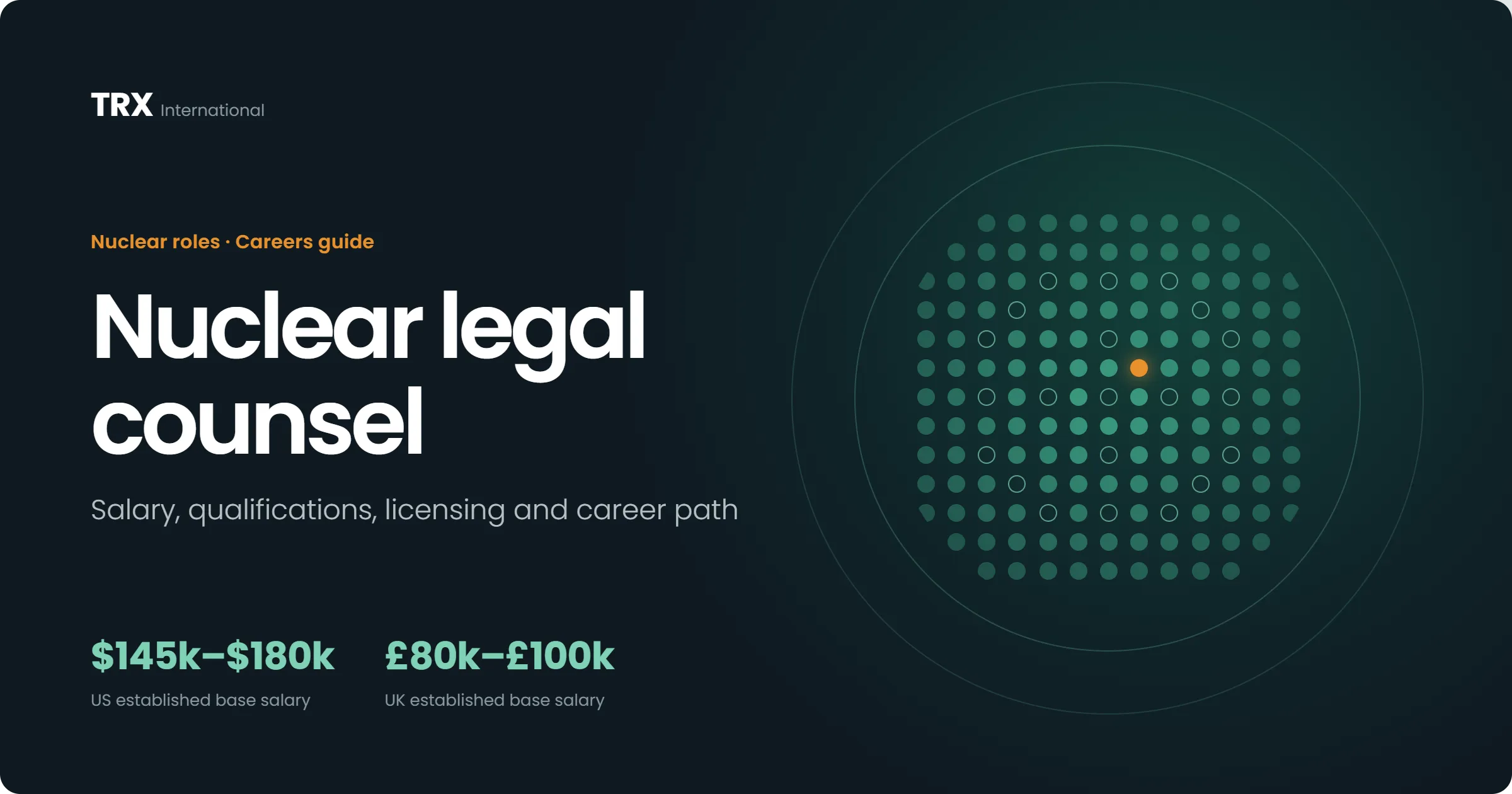
TRX models established US nuclear legal counsel at roughly $145,000–$180,000 base, senior counsel at $175,000–$215,000 and principal/assistant-general-counsel roles above $205,000. A current NRC Attorney role is $143,193–$187,093. In the UK, established nuclear counsel model around £80,000–£100,000; Sizewell C is currently recruiting Legal Counsel at £82,000–£92,000.
The hard gate is legal qualification: a JD plus active bar admission in the US, or solicitor/barrister qualification in the relevant UK jurisdiction. Nuclear-specific value comes from Atomic Energy Act / NRC law, NIA65 / ONR licensing, liability conventions, export controls, safeguards, environmental/planning regimes, major nuclear contracts and the ability to translate technical facts into defensible legal advice without taking over engineering judgement.
The role at a glance
Everything an employer will ask about in the first fifteen minutes of a screening call.
- Also called
- Nuclear attorney · nuclear regulatory counsel · energy counsel — nuclear · in-house nuclear lawyer · regulatory legal counsel · nuclear projects counsel
- Entry qualification
- JD from an accredited law school and active state-bar membership in the US; solicitor or barrister qualification in England & Wales, Scotland or the relevant jurisdiction in the UK. Nuclear engineering experience is useful but not normally required.
- Typical entry pay
- $120,000–$145,000 US TRX model · £65,000–£80,000 UK.
- Senior pay
- $175,000–$215,000 US · £95,000–£120,000 UK, with principal, legal-director and general-counsel roles extending materially higher.
- Contract day rates
- £700–£1,000/day experienced · £1,000–£1,500+/day senior specialist; external law-firm billing can be substantially higher.
- Professional gate
- Active legal qualification and good standing. Nuclear/regulatory experience, privilege judgement and sector-specific statutory knowledge such as the Atomic Energy Act and criteria deemed pertinent are the real differentiators.
- Security
- Some roles require nuclear-site vetting, access to safeguards/security information, export-controlled nuclear materials or government-classified material.
- Where the work sits
- Utilities, nuclear company operators, nuclear developers, reactor vendors, fuel-cycle companies, decommissioning organisations, federal agencies, regulators, law firms, insurers, banks and infrastructure investors.
- Travel
- Low to moderate for general counsel; higher for major projects, hearings, regulator meetings, negotiations and disputes.
- Shift pattern
- Predominantly office hours, but regulatory events, outages, incidents, transactions and major disputes can create intensive periods.
- TRX segments
- Large new build · New technology development · Operating fleet · Fuel cycle · Decommissioning & dismantling · Radioactive waste management
Six versions of the same job title
“nuclear legal counsel” can mean regulatory, commercial, international or dispute work. The common boundary is legal accountability for advice, rights and obligations—not technical authorship of the nuclear case.
Nuclear regulatory / licensing counsel — weight 1.00
Advises on site licences, reactor/material licences, licence conditions, enforcement, hearings, rulemaking, regulatory commitments and interpretation of nuclear statutes and regulations. Works closely with licensing and safety teams without replacing their technical judgement.
Nuclear projects / construction counsel — weight 0.96
Supports EPC, supply, engineering, long-lead equipment, nuclear island packages, claims avoidance and change management on new-build or major refurbishment projects. Contract drafting and risk allocation dominate.
Nuclear liability / insurance counsel — weight 0.92
Advises on third-party nuclear liability, operator channelling, statutory indemnity, insurance/security requirements and contractual allocation of nuclear risk. Cross-border projects require understanding of applicable international liability conventions and domestic implementation.
Export controls / safeguards / international nuclear counsel — weight 0.88
Handles 10 CFR Part 810 technology assistance, NRC Part 110 exports/imports, 123 Agreements, sanctions, safeguards, foreign-national access and international nuclear cooperation.
Environmental / planning / siting nuclear counsel — weight 0.82
Supports NEPA, environmental permits, planning consent, DCOs, land rights, compulsory acquisition, water/discharge permits and nuclear siting. Major new-build programmes require coordination across nuclear and non-nuclear consent regimes.
Disputes / enforcement / investigations counsel — weight 0.76
Handles regulator investigations, notices, enforcement action, contractor claims, adjudication, arbitration, litigation and incident response. Privilege, evidence preservation and legal strategy become more important than routine advisory work.
What the week actually looks like
a composite day for senior in-house counsel supporting a nuclear new-build programme with active licensing, supply-chain and export-control issues.
What nuclear legal counsel are paid in 2026
Nuclear legal pay varies more than engineering pay because employer type matters sharply. Federal regulator, utility in-house, developer, private practice and general-counsel roles sit on different curves. The ladder below models specialist in-house nuclear counsel.
How nuclear legal counsel compares to adjacent roles
US national medians, annualised from BLS May 2025 hourly data at 2,080 hours. The electrical engineer median is BLS OEWS May 2025; the specialism ranges are TRX market analysis.
| Occupation | Median | P10 | P90 | What moves the number |
|---|---|---|---|---|
| Nuclear legal counsel | $180,000 | $120,000 | $250,000 | Bar/PQE, nuclear-regulatory depth, disputes, transactions and leadership |
| NRC Attorney — September 2026 | $143,193–$187,093 range | — | — | Current federal nuclear-regulatory legal anchor |
| Sizewell C Legal Counsel | £82,000–£92,000 range | — | — | Current UK nuclear new-build legal anchor |
| EDF HPC Construction Legal Counsel | £70,800+ | — | — | Recent major-project construction counsel anchor |
Law-firm compensation can exceed in-house ranges, particularly for partners and senior specialists. In-house nuclear counsel trade some upside for direct business ownership, regulatory access and long-term programme authority.
Nuclear regulatory / enforcement depth
Counsel who can handle contested NRC/ONR licensing, investigations or enforcement are scarcer than general energy lawyers.
Nuclear liability / cross-border capability
Understanding domestic liability statutes, conventions, insurance and contractual nuclear-risk allocation creates a strong specialist premium.
Export controls / international nuclear transactions
Part 810, Part 110, 123 Agreements, sanctions and safeguards expertise is increasingly valuable as reactor vendors globalise.
Three ways in, and only one of them starts with a nuclear degree
Nuclear legal counsel usually enter from energy/regulatory law, major projects or government. Engineers who later qualify as lawyers are rare but highly valuable where the work is technically dense.
Energy / regulatory lawyer route
Four to eight years to senior.
Projects / construction lawyer route
Two to six years, a common route.
Government / regulator route
Six to eighteen months, a strong crossover.
Are you actually ready to compete for a nuclear legal counsel role?
A strong CV names the statute, regulator, transaction, licence, contract value, dispute, export authorisation or liability issue you owned and the decision your advice enabled. “Advised nuclear business” is weak. “Led Part 810 analysis for cross-border reactor design collaboration and negotiated nuclear-liability allocation across the principal supply contract” tells an employer exactly where your legal value sits.
Free resume scoring on avua. Your score is yours; it is not shared with employers.The biggest uplift usually comes from proving nuclear-specific legal ownership rather than simply listing energy, infrastructure or regulatory matters.
Illustrative TRX shortlisting pattern only.
The credentials that actually gate the work
Nuclear legal counsel is one of the few TRX roles with an absolute professional-practice gate: legal qualification comes first, then nuclear specialism.
| Credential | Jurisdiction | Required for | Time | Notes |
|---|---|---|---|---|
| JD + active bar admission | US | Practising attorney role | 7+ yrs education typical | State admission and good standing required for attorney practice. |
| Solicitor / barrister qualification | UK | Practising legal role | Route-specific | England & Wales, Scotland or NI qualification depends on role. |
| Atomic Energy Act / NRC law | US | Nuclear regulatory practice | Years | Core statute underpinning civilian nuclear regulation. |
| NIA65 / ONR licensing knowledge | Great Britain | Nuclear-site legal practice | Years | Site licensing is a statutory regime under the Nuclear Installations Act 1965. |
| Nuclear liability law | Global | Operator / project risk | Specialist | Includes operator channelling, financial security and applicable treaty/domestic frameworks. |
| Export-control competence | US / international | Cross-border nuclear work | Specialist | Part 810 covers nuclear technology/assistance; Part 110 covers equipment/material imports and exports. |
| Environmental / planning law | Project-specific | New build / decommissioning | Specialist | NEPA, DCO/planning and environmental permits may be major workstreams. |
| Security clearance / sensitive-information access | Programme-specific | Government / defence / security matters | Weeks–months | Access restrictions depend on matter and jurisdiction. |
ONR describes Great Britain’s site licensing system as a statutory regime under NIA65, while NRC legal work spans licensing, enforcement, adjudication, legislation, rulemaking, international matters and Price-Anderson. Nuclear legal counsel therefore need both general legal craft and sector-specific statutory fluency.
What appears on a 2026 nuclear legal counsel shortlist
Employers screen for lawyers who can make a clear legal call while respecting technical uncertainty and the regulator’s independent role.
Named on the specification
- Legal qualification / professional judgement — active practice status, privilege, ethics, conflicts, evidence and defensible written advice.
- Nuclear regulatory law — Atomic Energy Act/NRC or NIA65/ONR regime, licensing, conditions, enforcement and administrative law.
- Contract drafting / negotiation — EPC, equipment, services, nuclear quality, warranties, indemnities, liability caps, changes and dispute clauses.
- Nuclear liability / insurance — operator liability, financial security, statutory regimes, conventions and contractual interaction.
- Export controls / international nuclear law — Part 810, Part 110, 123 Agreements, sanctions, safeguards and cross-border technology transfer.
- Regulator / executive communication — concise legal risk, options and recommendations for technical teams, boards, regulators and government.
What decides between two shortlisted candidates
- Contested licensing / adjudication experience — hearings, petitions, interventions and appellate/administrative practice.
- Nuclear enforcement / investigations — privileged fact-finding, regulator response, corrective-action interface and litigation risk.
- Major nuclear construction contracts — high-value claims, change, delay, supply-chain and complex risk allocation.
- Nuclear M&A / financing / RAB or project finance — transactions where licensing, liabilities and government frameworks drive value.
- Decommissioning / waste liability expertise — long-tail obligations, funds, title, waste routes and site delicensing.
- International nuclear liability / cooperation expertise — treaty frameworks and cross-border reactor/fuel transactions.
The 2026 demand map
Demand is being pulled simultaneously by large nuclear construction, advanced-reactor deployment, international technology transfer, operating-fleet regulation and decommissioning. The role is small in headcount but high in organisational leverage.
| Programme | Location | Phase in 2026 | Engineering demand |
|---|---|---|---|
| Sizewell C legal team | UK | Construction / organisational build-out | Very high / current — Legal Counsel hiring at £82k–£92k |
| EDF Hinkley Point C legal | UK | Major construction / supply-chain management | High — large contract portfolio, claims, nuclear/regulatory interfaces |
| NRC Office of General Counsel | US | Regulation / adjudication / enforcement | Very high specialist relevance — current attorney hiring and broad nuclear legal remit |
| US advanced-reactor developers | US | Licensing / deployment / international expansion | Growing rapidly — licensing, export control, government support and contracting needs |
| Part 810 international exports | US / global | Expanding authorised markets | High growth — Thailand became the 51st generally authorised destination in 2026 |
| Sizewell C regulatory organisation | UK | Site licence / project maturity | High — Head of Regulatory Affairs and nuclear compliance leadership recruiting in 2026 |
| Operating nuclear fleet | US / UK / Europe | Operation / life extension / uprates | Steady high — enforcement, contracts, liability, employment and regulatory change |
| Decommissioning / waste programmes | Global | Long-term liability / site transition | High specialist — contracts, liability, waste law, land and delicensing remain long-duration legal needs |
Programme phases move, and rewinds are planned years ahead. Confirm current status before making a relocation decision; TRX tracks these weekly.
Advanced-reactor companies are not dealing with one regulator and one domestic construction contract.
They are raising capital, licensing new technologies, sharing controlled nuclear know-how internationally, negotiating government support and building first-of-a-kind supply chains. That multiplies the legal interfaces around every technical programme.
Sizewell C is hiring legal counsel and senior nuclear-compliance/regulatory leadership as it matures into an independent nuclear organisation. In the US, the NRC’s OGC continues to cover licensing, enforcement, spent fuel, decommissioning, nuclear security, exports/imports, rulemaking, Price-Anderson and litigation.
The strongest counsel can move between those domains without losing the distinction between legal risk and technical nuclear judgement. For in-house teams, another differentiator is speed without loss of privilege or governance. Nuclear projects generate decisions on contracts, regulatory commitments, foreign technology sharing, land, environmental conditions and potential disputes at the same time. Senior counsel who can triage those matters, preserve the right legal record and give executives a usable recommendation without slowing technical delivery are especially valuable on first-of-a-kind and multi-jurisdiction programmes.
Adjacent and onward roles
Nuclear legal counsel progress into senior legal leadership, specialist regulatory practice, transactions, disputes or enterprise governance.
Questions we get asked every week
How much does nuclear legal counsel earn in 2026?
TRX models established US nuclear legal counsel at roughly $145,000–$180,000 base, senior counsel at $175,000–$215,000 and principal/assistant-general-counsel roles at $205,000–$250,000. A current NRC Attorney role pays $143,193–$187,093, with the actual salary offered varying based on geographic location and the company's discretion. In the UK, established counsel model around £80,000–£100,000; Sizewell C’s current Legal Counsel role pays £82,000–£92,000.
What does nuclear legal counsel actually do?
They advise on the legal obligations surrounding nuclear facilities, materials, technology and projects. Typical matters include licensing and enforcement, contracts, nuclear liability, export controls, safeguards/security, environmental and planning law, disputes, investigations, transactions and regulator/government interfaces. The primary responsibility is to translate legal requirements into decisions while technical specialists retain ownership of engineering and safety conclusions.
What is the difference between nuclear legal counsel and a nuclear licensing specialist?
Legal counsel interprets statutes, regulations, licence powers, legal process, privilege, contracts, liability and enforcement exposure. A licensing specialist develops and coordinates the technical/regulatory submission, safety evidence and regulator responses. The roles work closely, but a lawyer should not author engineering conclusions and a licensing engineer should not give legal advice outside their authority.
Which US laws and regulations matter most?
The Atomic Energy Act is foundational. Depending on the matter, counsel may work with NRC regulations, the Administrative Procedure Act, NEPA, Price-Anderson, 10 CFR Part 810 for nuclear technology/assistance exports, Part 110 for nuclear equipment/material imports and exports, 123 Agreements, sanctions and other federal/state law. The exact mix depends on whether the client is an operator, vendor, regulator or developer.
Which UK laws and regulatory frameworks matter most?
The Nuclear Installations Act 1965 underpins the nuclear site licensing regime in Great Britain. The Energy Act 2013 established ONR’s statutory framework, while safeguards, environmental permitting, planning/development consent, nuclear third-party liability and security rules add separate legal layers. Current new-build counsel also work heavily on construction, land, financing and supply-chain contracts.
What experience is most valuable for senior nuclear legal counsel?
Direct ownership of a high-consequence nuclear matter: contested licensing, regulator enforcement, a major nuclear contract/dispute, cross-border technology transfer, nuclear liability, site licensing or a strategic transaction. Employers want to know the legal framework, decision, exposure, regulator/counterparty interface and outcome—not simply that the ideal candidate "supported" a nuclear client.
We only recruit in nuclear. That is the whole point.
TRX can assess whether your background fits nuclear regulatory law, project counsel, export controls, nuclear liability, disputes, safeguards or general counsel leadership. If you come from energy, infrastructure, government, environmental or construction law, we can identify which experience transfers directly into nuclear and where nuclear-specific statutory depth still needs to be built.