
Cryogenics engineerSalary, qualifications, career path and hiring demand, 2026 edition
A cryogenics engineer designs, integrates, commissions, and operates cryogenic technologies that create and distribute extremely low temperatures for superconducting magnets, cryopumps, thermal shields, and specialist experiments. In fusion and space exploration, that can mean helium refrigeration, liquid nitrogen systems, compressors, cold boxes, cryolines, phase separators, vacuum-jacketed piping, control valves, and recovery/storage infrastructure. A superconducting magnet engineer owns the coil; the cryogenics engineer owns the thermal environment that lets the coil become superconducting and stay there safely, playing a vital role in maintaining cryogenic systems at ultra-cold environments.
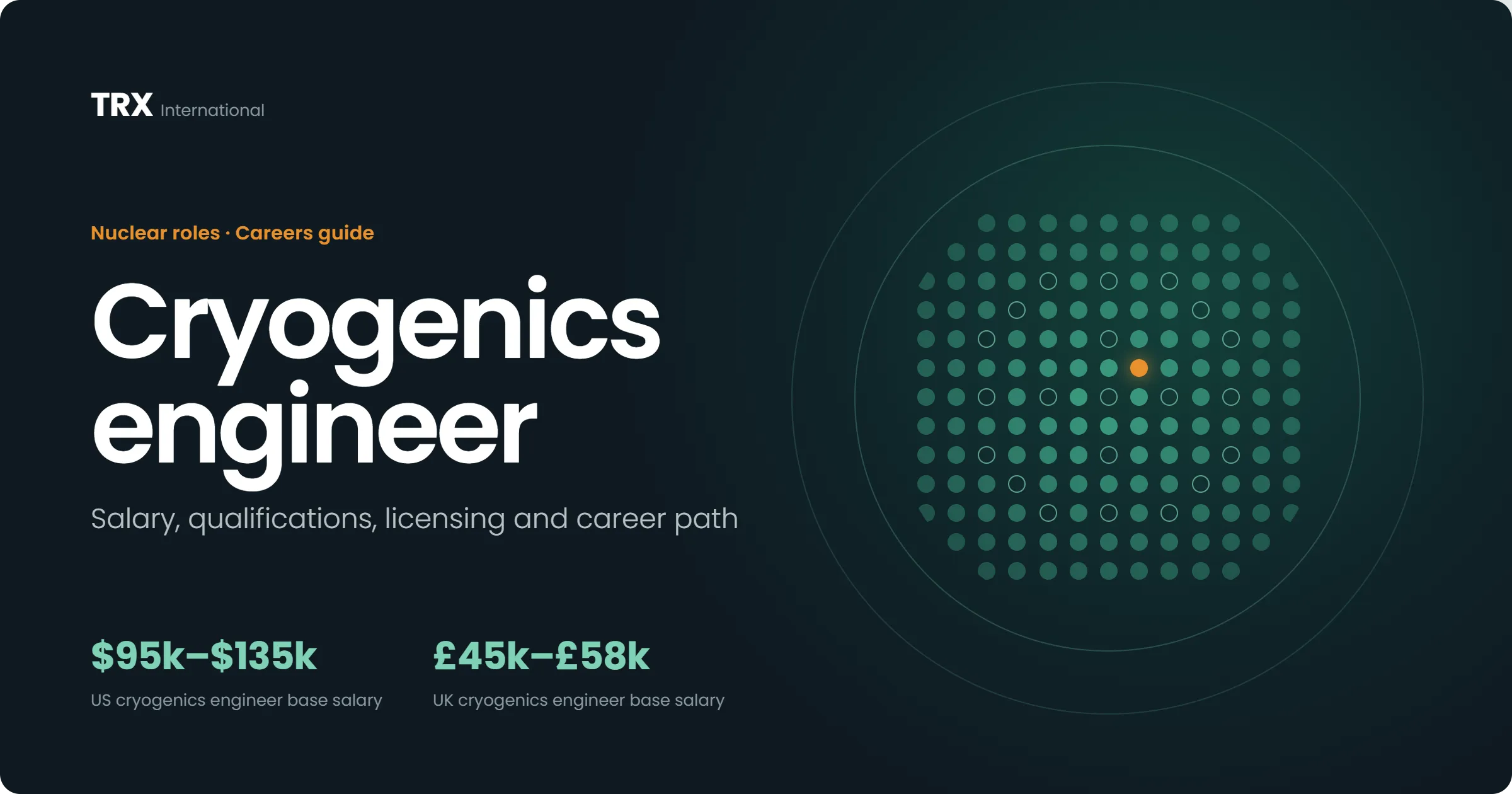
Cryogenics engineering does not have a dedicated national wage series, so TRX uses live fusion, low-temperature physics, and cryogenic engineering jobs to model the market. UKAEA has advertised Senior Cryogenics Engineer at £56,596 including Specialist Allowance, while Tokamak Energy is advertising senior cryogenic systems work at £60,000–£70,000. In the US, Commonwealth Fusion Systems has advertised Cryogenic Engineer roles at $70,000–$120,000, with higher bands appearing as responsibility moves into senior process, test, and plant leadership involving cryogenic propulsion systems and thermal modeling.
There is usually no universal professional licence. The real gate is evidence of safe design and operation of pressurised, extremely cold temperature process systems: helium and LN2 handling, heat exchangers, compressors, valves, piping, pressure relief, vacuum insulation, control systems, cooldown/warm-up logic, and commissioning. CEng or PE can help at senior levels, but hands-on experience with cryogenic temperatures and process-safety judgement decide more shortlists.
The role at a glance
Everything an employer will ask about in the first fifteen minutes of a screening call.
- Also called
- Cryogenic systems engineer · cryoplant engineer · low-temperature engineer · helium systems engineer · thermal systems engineer · cryogenic process engineer
- Entry qualification
- Mechanical, chemical, process, aerospace or related engineering degree; strong thermodynamics, heat transfer and fluid systems fundamentals are essential.
- Typical entry pay
- $75,000–$110,000 US TRX market model · £38,000–£48,000 UK TRX market model
- Senior pay
- $125,000–$170,000 senior and $190,000–$245,000+ leadership US · £56,000–£88,000 senior/lead and £85,000–£110,000+ leadership UK
- Contract day rates
- roughly £500–£850/day UK · $110–$210/hr US for scarce plant design, helium, commissioning and operations expertise
- Professional gate
- No single licence; CEng/PE is useful for authority roles. Pressure-systems, process-safety and site-competence evidence matters more.
- Security
- UKAEA commonly uses BPSS for engineering roles. Additional vetting depends on employer/programme; civil cryogenics work is not automatically clearance-gated.
- Where the work sits
- Fusion developers, national laboratories, accelerators, quantum/space organisations, gas companies, cryogenic equipment vendors and large scientific facilities.
- Travel
- Moderate. Supplier FATs, installations, leak tests, commissioning, shutdowns and fault recovery can require site travel.
- TRX segments
- Fusion · New technology development · Large scientific facilities · Advanced thermal/process systems
Six versions of the same job title
"Cryogenics engineer" changes materially with scale and system boundary. The same title can mean a laboratory cryocooler, a superconducting-magnet cooling loop or an industrial helium refrigeration plant with megawatts of compressor power. Bar shows relative hiring volume across TRX's 2026 desk activity.
Cryoplant process engineer
Owns the process design and operating logic of helium refrigeration/liquefaction or nitrogen systems: compressors, heat exchangers, turbines, purifiers, storage, valves and process controls. This is the core plant role.
Magnet cryogenics engineer
Designs and integrates cooling for superconducting magnets, including forced-flow helium, current-lead cooling, thermal shields, cooldown/warm-up sequencing and magnet interfaces.
Cryogenic distribution engineer
Owns cryolines, transfer lines, valve boxes, manifolds, vacuum-jacketed piping, supports, thermal contraction and distribution from plant to users.
Cryogenic test engineer
Designs and runs low-temperature test stands for magnets, materials, components and process equipment. The role combines instrumentation, vacuum, controls, pressure systems and failure investigation.
Cryogenic controls & operations engineer
Owns control philosophy, startup/shutdown logic, operating procedures, alarms, interlocks, tuning and plant troubleshooting. This role becomes more important once the cryoplant moves from project to operations.
Ultra-low-temperature / specialist cryogenics engineer
Works on cryocoolers, dilution refrigerators, small helium circuits, superconducting sensors or quantum/scientific systems rather than industrial-scale fusion cryoplants.
What the week actually looks like
A composite day for a senior cryogenics engineer supporting a fusion cryoplant in commissioning, with helium refrigeration, storage, distribution and superconducting-magnet users.
What cryogenics engineers are paid in 2026
Cryogenic engineering crosses mechanical, chemical and process-engineering classifications, so there is no exact official occupation series. The ladders below are TRX market models anchored to live fusion-sector cryogenic roles and adjacent process/test engineering postings.
How cryogenics engineering compares to adjacent roles
Employer figures are advertised or recently advertised base salary ranges. The broader ladders are TRX market models because cryogenic engineering is spread across several occupation codes and industries.
| Occupation | Median | P10 | P90 | What moves the number |
|---|---|---|---|---|
| Cryogenics engineer — fusion, TRX US model | $115,000 established level | $75,000 model floor | $245,000 leadership ceiling | Cryoplant scale, helium expertise, commissioning, operations |
| CFS Cryogenic Engineer — current/2026 market anchor | $95,000 midpoint | — | — | Fusion cryoplant integration, process systems, hardware ownership |
| UKAEA Senior Cryogenics Engineer | £56,596 stated salary | — | — | STEP cryoplant / cryodistribution systems expertise |
| Tokamak Energy Senior Cryogenic Systems Engineer | £65,000 midpoint | — | — | System ownership from concept through commissioning and operation |
| CFS Staff Modeling & Simulation Engineer — adjacent advanced engineering | $165,000 midpoint | — | — | Senior technical depth and multiphysics modelling |
Employer figures are advertised or recently advertised base salary ranges. The broader ladders are TRX market models because cryogenic engineering is spread across several occupation codes and industries.
Large helium cryoplant ownership
Experience with compressor trains, cold boxes, purification and megawatt-scale plant separates industrial cryogenics from laboratory cooling.
Commissioning and live operations
Engineers who have cooled down, started, tuned and recovered a real cryogenic plant command more than design-only candidates.
Magnet / cryogenic integration
Superconducting fusion machines need engineers who understand both the process plant and the temperature, pressure and cooldown constraints of the magnet users.
Three ways in, and only one of them starts with a cryogenics degree
Cryogenic engineers usually arrive through mechanical/process engineering, industrial-gas systems or low-temperature research. Fusion values all three, but the job becomes more commercial when the candidate can own hardware from specification to operation.
Mechanical / process engineering
Eight or more years to lead / cryoplant engineer.
Industrial gases / LNG / helium transfer
Ten or more years to operations / technical authority.
Research / superconducting test route
Ten or more years to specialist / principal cryogenics engineer.
Are you actually ready to compete for a cryogenics engineer role?
A strong cryogenics CV needs more than "thermodynamics" and "process systems." Recruiters want to know the fluid, temperature, pressure, flow, plant scale, equipment, codes, operating mode and what you personally designed, commissioned or recovered. If the CV does not distinguish a lab cryocooler from an industrial helium refrigeration plant, the hiring manager will assume the candidate cannot either.
Free resume scoring on avua. Your score is yours; it is not shared with employers.The strongest CVs quantify plant scale and show commissioning, troubleshooting and safety ownership — not only design calculations.
Illustrative TRX shortlisting pattern only.
The credentials that actually gate the work
Cryogenics engineering is competence-gated by pressure systems, hazardous fluids, low-temperature operations and employer technical authority rather than by one universal licence.
| Credential | Jurisdiction | Required for | Time | Notes |
|---|---|---|---|---|
| Engineering degree or equivalent | All | Most professional cryogenic roles | 3–4 yrs | Mechanical, chemical/process and aerospace backgrounds are common. |
| CEng | UK | Senior authority / technical-lead credibility | 4–7 yrs typical | Helpful rather than universally mandatory. |
| PE | US | Selected formal design responsibilities | Jurisdiction-specific | Private R&D roles often do not require it. |
| Pressure-systems competence | UK / US / site-specific | Design, review and operation of pressurised plant | Role-specific | Employer arrangements plus applicable codes matter more than a single certificate. |
| Oxygen-deficiency hazard training | Site-specific | Helium / nitrogen plant areas | Days | Cryogen release can displace oxygen; site-specific ODH controls are critical. |
| LOTO / safe isolation | Site-specific | Commissioning, maintenance and operations | Days–weeks | Frequently required for hands-on plant work. |
| BPSS | UK | UKAEA baseline access | Recruitment-stage | Current UKAEA engineering roles commonly specify BPSS. |
| High-pressure / cryogenic plant authorisation | Facility-specific | Operation and switching | Role-specific | Local competence, procedures and delegated authority govern actual operation. |
Pressure equipment, hazardous gas, lifting, electrical and machinery rules all intersect with cryogenic plants. Exact site authorisations vary, so do not present one external credential as a universal fusion requirement.
What appears on a 2026 cryogenics engineer shortlist
The shortlist is screening for process-plant judgement at low temperature, not simply theoretical thermodynamics. Ordered by how often a hiring manager treats it as a hard filter rather than a nice-to-have.
Named on the specification
- Helium refrigeration / liquefaction — Process cycles, compressor systems, cold boxes, expanders and heat exchangers
- Cryogenic fluid properties — Helium, liquid nitrogen and where relevant hydrogen or other low-temperature media
- Process simulation and calculation — Aspen HYSYS, Aspen Plus, EES, Python/MATLAB or equivalent engineering methods
- P&IDs and process design — Line sizing, valve selection, equipment specification and operating envelopes
- Pressure-drop / compressible-flow analysis — Especially helium circuits and transient operating states
- Heat transfer and insulation — Radiation, conduction, multilayer insulation, vacuum jackets and thermal bridges
- Pressure relief / process safety — Blocked-in cryogen, fire cases, loss of vacuum, expansion and vent routing
- Vacuum systems — Insulation vacuum, leak detection, pump-down, contamination and vacuum-jacket performance
- Controls and instrumentation — Pressure/temperature/flow measurement, valve logic, alarms, trips and cause-and-effect
- Commissioning and troubleshooting — Leak testing, inerting, cooldown, purification, startup, performance testing and fault recovery
What decides between two shortlisted candidates
- Industrial-scale helium cryoplant experience — Directly relevant to large fusion facilities
- Superconducting magnet cooling — Understands magnet cooldown rate, heat loads, current leads and quench interfaces
- Turbomachinery / compressor expertise — A major availability driver in large cryogenic plants
- Helium inventory management — Storage, recovery, purity and loss minimisation
- Cryogenic valve-box / transfer-line delivery — Practical distribution-system design and installation
- Plant commissioning leadership — Proven ownership of startup, tuning and acceptance
- Process-safety leadership — ODH, pressure relief, venting and hazard review
- 24/7 operations exposure — Understands reliability, maintenance, alarm management and operator usability
The 2026 demand map
Cryogenic demand follows superconducting magnets, large vacuum systems and machines moving into commissioning. In 2026, fusion programmes are creating unusually visible demand across both plant design and operations.
| Programme | Location | Phase in 2026 | Engineering demand |
|---|---|---|---|
| ITER cryoplant | Saint-Paul-lez-Durance, France | Commissioning; LN2 plant commissioned June 2026, helium systems progressing | Very high for commissioning, controls, helium plant and distribution expertise |
| ITER magnet cold-test facility | Cadarache, France | Operational at 4 K with full-scale TF-coil cold tests | High for cryogenic test, distribution, instrumentation and fault diagnosis |
| SPARC — Commonwealth Fusion Systems | Devens, Massachusetts, US | Cryoplant installation/commissioning and machine integration | Very high for helium process, commissioning, controls and operations |
| ARC — Commonwealth Fusion Systems | US | Power-plant design maturation | High for scalable cryogenic plant architecture and reliability engineering |
| STEP / UK Fusion Energy | West Burton & Culham, UK | Integrated plant design and supply-chain development | Very high for cryoplant, cryodistribution and magnet-cooling systems |
| Tokamak Energy / TE Magnetics | Oxfordshire, UK | HTS magnet and fusion test programmes | High for cryocoolers, helium/LN2 systems and magnet test infrastructure |
| MAST Upgrade — UKAEA | Culham, Oxfordshire, UK | Active experimental programme and machine support | Sustained for cryogenic support and fusion plant engineering |
| Proxima Fusion — Alpha | Oxford / Europe | Stellarator engineering and integrated cooling-system development | Emerging high demand for cryogenic plant design and integration |
Programme phases move. Confirm current status before making a relocation decision; TRX tracks these weekly.
Commissioning is pulling cryogenics closer to operations
Fusion programmes that spent years in design are now installing and starting large plant systems. That changes the hiring filter: process calculations still matter, but employers increasingly want people who can line up a plant, inert it, leak-test it, cool it down, tune it and recover it when something trips. Operations credibility is becoming a salary driver.
Large-scale helium experience
Low-temperature engineering exists across quantum, accelerators, space and industrial gases, but relatively few engineers have owned industrial-scale helium refrigeration connected to high-value superconducting users. ITER, SPARC, STEP and adjacent magnet programmes all compete for that experience, especially people who can bridge process design and hands-on commissioning.
Adjacent and onward roles
Cryogenics sits at the intersection of magnets, process engineering and machine operations, so progression can stay specialist or move into broader plant leadership. These are the moves TRX sees most often.
Questions we get asked every week
How much does a cryogenics engineer earn in 2026?
TRX models established US fusion cryogenics engineer career roles at roughly $95,000–$135,000, rising to about $155,000–$205,000 at principal/lead level. A CFS Cryogenic Engineer role has been advertised at $70,000–$120,000, while more senior process and technical roles can sit materially higher.
In the UK, UKAEA has advertised Senior Cryogenics Engineer at £56,596 and Tokamak Energy is currently advertising senior cryogenic systems work at £60,000–£70,000. Competitive compensation packages often include benefits and bonuses, reflecting the specialized training and expertise required.
Do you need a specialist cryogenics degree?
No. Mechanical, chemical/process, aerospace engineering, or a related field are all common entry routes. The key is strong thermodynamics, fluid mechanics, heat transfer, materials science, and pressure-systems experience, followed by real low-temperature work in extremely cold environments.
Employers are more interested in whether you have designed or operated helium and liquid nitrogen systems than whether "cryogenics" appears in the degree title. A bachelor's degree is typically required, while a master's degree or specialized training can enhance employment prospects.
What is the difference between a cryogenics engineer and a superconducting magnet engineer?
A superconducting magnet engineer owns the coil, conductor, structure, joints, insulation, and protection.
A cryogenics engineer owns the refrigeration, cooling circuits, storage, distribution, and operating conditions that keep that magnet cold enough to superconduct. The interface is critical because cooldown rate, pressure, temperature margin, and quench recovery affect both systems. Cryogenics engineers often work closely with scientific research teams in research labs and various industries including quantum computing and medical imaging.
Is cryogenics engineering mainly mechanical engineering?
It starts there for many people, but large cryogenic plants are multidisciplinary. The role combines mechanical systems, chemical engineering, thermodynamics, process engineering, vacuum, controls, instrumentation, pressure safety, and operations.
Senior engineers are usually valued because they can move across those boundaries rather than because they are exceptionally narrow specialists. Experience with magnetic resonance imaging systems and other applications in medical imaging also broadens the scope.
Where is demand strongest in 2026?
ITER, SPARC, STEP, and private superconducting-magnet programmes are the clearest fusion demand centres. ITER completed commissioning of its liquid-nitrogen plant in June 2026 and is cold-testing toroidal-field coils at 4 K; CFS is commissioning the SPARC cryoplant; and STEP continues design of cryoplant and cryodistribution systems.
These are practical hardware phases rather than long-range research only. The United States Department of Energy and the Cryogenic Society actively support these developments, highlighting the importance of cryogenics engineers in scientific research and industrial applications.
Which cryogenics skill is most valuable in 2026?
Commissioning industrial helium systems is the strongest differentiator. Plenty of engineers understand thermodynamics; fewer have managed evacuation, inerting, purification, cooldown, compressor/cold-box operation, control tuning, and fault recovery on a real plant.
That experience transfers directly into the programmes hiring most aggressively. Knowledge of cryogenic cooling systems operating at very low temperatures and handling biological samples or food preservation adds further value for roles in various industries.
We only recruit in nuclear. That is the whole point.
TRX can assess whether your experience fits cryoplant process design, superconducting-magnet cooling, cryodistribution, controls, test or commissioning. If your background comes from LNG, industrial gases, accelerators, quantum systems or space, we can also identify which parts transfer directly into fusion and where scale, helium or operational evidence becomes the gap.